Our insights
Where city futures are locked in

Insight
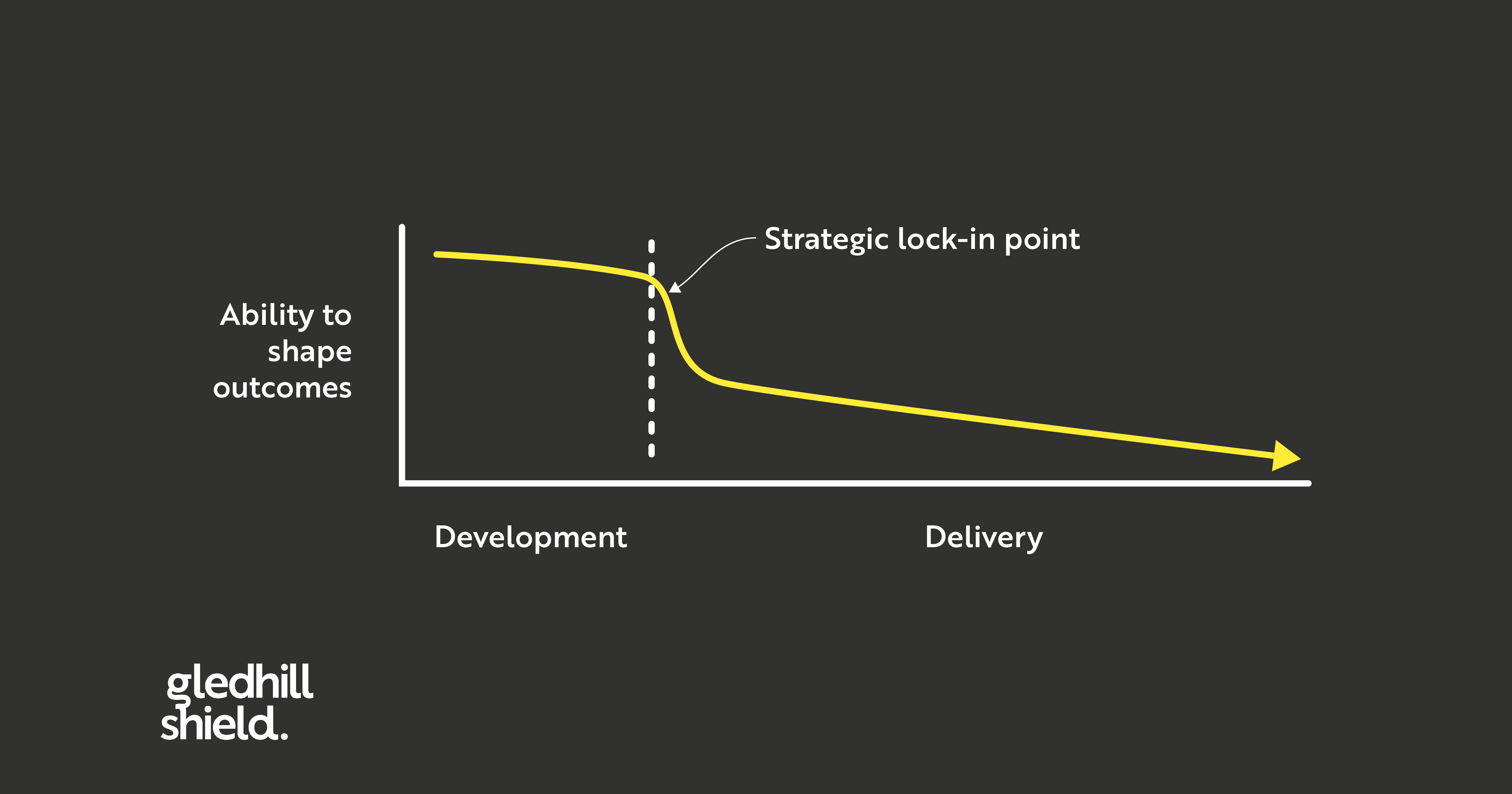
Most city and infrastructure outcomes are largely set before construction begins — when investment cases are developed, options tested and concept designs formed. By the time delivery starts, the trajectory of a major project is locked in.
Cities now have access to more data than ever. But the challenge they face is not a lack of information, but the absence of responsibility for the choices that shape their future. By the time a project is wrestling with cost overruns or public backlash, the future it will deliver is already largely locked in. The execution that follows — no matter how skilful or heroic — can only optimise within a narrow band of opportunity established by choices made much earlier under conditions of uncertainty, pressure and optimism. The real failure point in city-shaping projects is rarely delivery itself. It lies in how early choices are framed, authorised and defended.
Roger Martin defines strategy as an integrated set of choices that positions an organisation to win. If that definition holds for cities as well as firms, an obvious question follows: where, in practice, are those choices actually made?
In most cases, the answer is earlier than we like to admit.
Project success is determined early
Decades of research by Bent Flyvbjerg and others show that the greatest risks in major projects are not technical but human and institutional. Optimism bias, political pressure and incentive structures that reward expediency over accuracy shape decisions at the front end, long before construction begins.
Two observations follow from this work. First, outcomes are heavily front-loaded. Cost, scope, benefit realisation and public value are largely determined early in the lifecycle, when uncertainty is highest and scrutiny is weakest. Second, the sense of control later in the project lifecycle is largely illusory. Once momentum builds, governance shifts from shaping direction to managing consequences.
Reference class forecasting helps counter this dynamic by comparing a proposed project with the real-world performance of similar ones. It disciplines optimism and forces decision-makers to confront what usually happens rather than what they hope will happen. This realism is essential. But realism alone does not determine what a project is meant to become.
Benefits are too often unrealised
Flyvbjerg’s research also shows that many projects fail not only on cost and schedule but on benefits. Demand is overstated, wider impacts exaggerated and promised value frequently fails to materialise.
This pattern reflects a governance problem as much as a forecasting one. Benefits are typically defined early, yet once delivery begins, they are rarely defended with the same rigour as cost and schedule. What can be readily measured is secured, while what is civic, experiential or long-term becomes negotiable.
Delivery systems are highly effective at completing projects, but far less effective at protecting the outcomes those projects were originally intended to create. When ambition narrows under pressure, the result is not only a diminished project but a different future than the one that was originally promised, with long-term asset performance falling short of what the investment was meant to deliver.
Defining what counts as a benefit is therefore not merely technical. It is a strategic decision that commits to a particular future and determines the extent to which benefits will flow from the investment.
The implication we avoid
If early decisions shape outcomes this powerfully, then the quality of judgement at that moment matters more than anything that follows. Yet this is precisely where most systems are weakest.
At the front end of major projects responsibility for the whole is diffuse. Authority is fragmented across agencies and disciplines, and trade-offs are often resolved implicitly rather than deliberately. Teams may be aligned, expertise abundant and processes carefully followed, but no single actor is clearly authorised to hold the integrity of the project as a coherent whole.
When pressures inevitably arise, decisions are taken that narrow or reinterpret earlier commitments. Non-statutory accessibility features may be reduced, public realm ambitions scaled back, or social value initiatives extinguished during value engineering. In isolation each change may appear reasonable. Collectively they can alter the nature of the project in ways that were never explicitly chosen and, most critically, undermine long-term asset performance, often in ways that are difficult to recover once capital has been deployed.
Why existing tools fall short
We do have tools to address these challenges, but they are too often deployed too late in the process and not consistently enabled through organisational structures.
Benefits are defined in business cases and decisions are supported by multi-criteria assessments and assurance frameworks. By the time a multi-criteria assessment is running, ambition has usually been flattened into variables that can be scored. What is long-term, experiential or cultural is translated into weak proxies, or disappears entirely.
The result is not irrational decision-making. It is decisions made inside a narrowed frame that no one explicitly chose.
A human analogy
Parenting offers a clear parallel. We know what harms children. Instability and neglect reliably produce poor outcomes. Avoiding these failures is responsible, but it falls short of great parenting. Flourishing requires more than harm reduction. It requires someone responsible for supporting who that child might become.
In projects, intent clarifies what an intervention is meant to achieve. Boundaries define what will not be compromised under pressure. Stewardship is the responsibility to hold all of this coherent over time.
Reference class forecasting helps prevent harm by disciplining realism and revealing what usually goes wrong. But it does not tell us what this project is meant to become, what it should enable, or what must be protected when pressures emerge.
What happens when intent fails
The consequences of this are not abstract. They shape economic performance directly.
Theme parks illustrate this clearly. They succeed when every decision is anchored to a clear human purpose: helping people create meaningful memories with those they love. That clarity produces coherence across design, operations, pricing and scale. Trade-offs are not eliminated, but they are resolved consistently against that purpose. Their economic success is the result of sustained alignment around intent.
In 2001, Disney California Adventure opened next to Disneyland. Created as a pastiche of California icons, the park relied on lower-cost attractions and lacked the family-focused, immersive, character-led qualities that define Disney’s other parks. While it broadly met time and cost expectations, it failed to deliver the experience people seek from a Disney theme park.
Built for around $600 million, the park struggled with lower-than-expected visitation. Within six years, Disney committed a further $1.1 billion to rebuild it — re-anchoring the park around story, place and guest experience. The issue was not delivery. It was that the original intent was mis-specified, and capital had been committed to the wrong proposition.
Design as integration
Design is the discipline that translates intent into form. At its best, it operates at the intersection of engineering constraints, human experience, cost, constructability and long-term operation.
In many projects, however, design enters only after the most consequential strategic choices have already been made — at the point where capital is committed and direction becomes difficult to change. In that position, it is asked to mitigate impacts or soften trade-offs decided elsewhere. When design enters late, its role becomes mitigation: responding to decisions already made rather than shaping them. When it enters earlier, it becomes integration: aligning constraints, experience and long-term outcomes before they diverge.
For design to perform this role effectively, designers who wish to shape city futures must become more comfortable with strategic thinking, trade-offs and the realities of delivery, while remaining attentive to human experience. Strategy without human clarity becomes abstract. The strength of design thinking lies in keeping intended outcomes visible as complexity increases.
Strategic commitment
What is missing in many city-shaping projects is not data, process or expertise. It is strategic commitment at the moments when futures are effectively locked in — when capital is committed and trade-offs are set.
Strategic commitment is the structure through which consequential choices are made and defended: who defines intent, who resolves trade-offs, how competing values are integrated, and who holds the integrity of the project as pressure mounts. It sits at the point where intent becomes capital commitment.
This is the focus of Gledhill Shield’s work: helping institutions make and defend these choices at the moments where intent becomes capital commitment.
The elements of strategic commitment
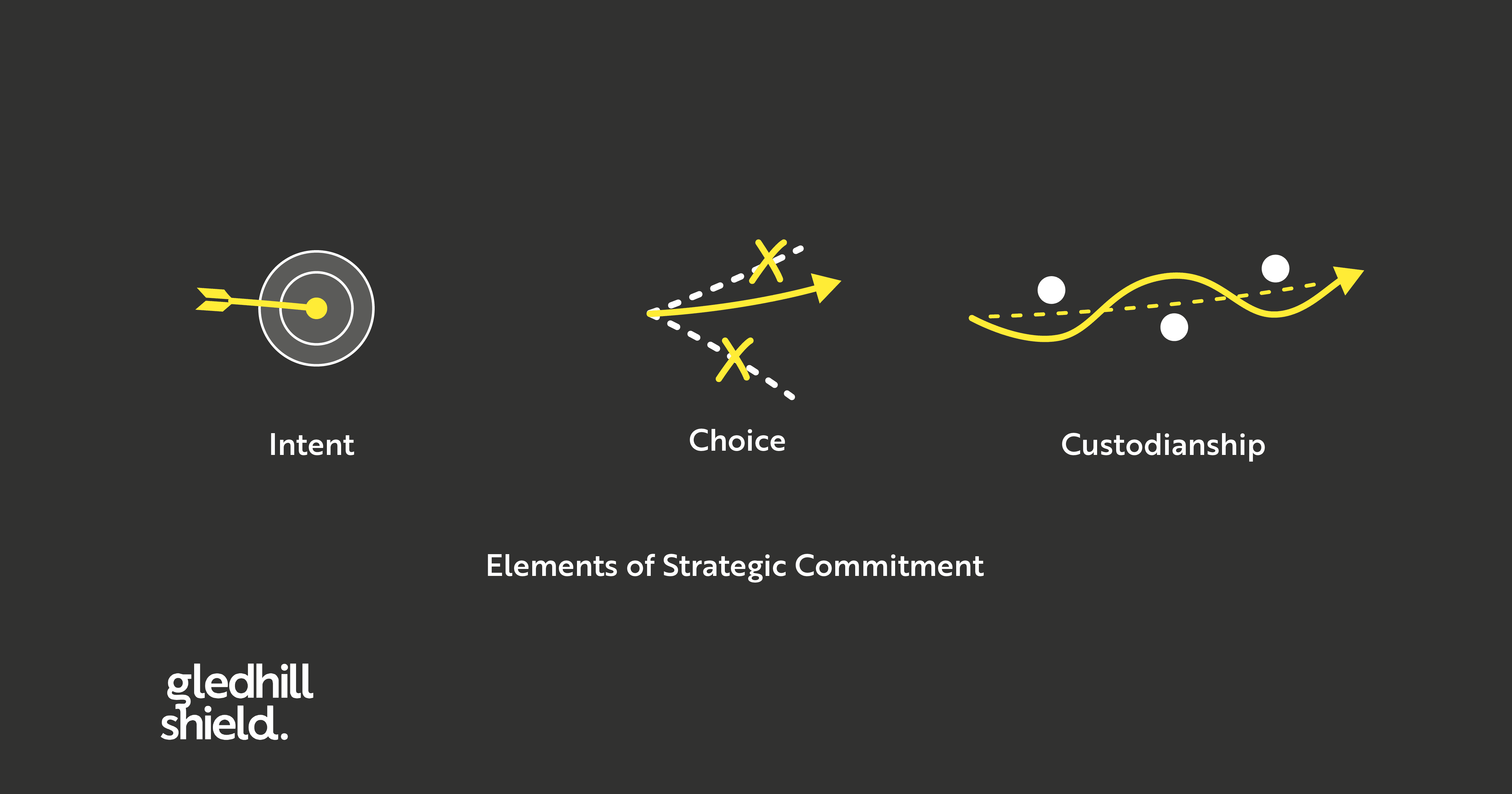
In practice, strategic commitment rests on three elements: intent, choice and custodianship.
Intent
A clear articulation of the future the project is meant to create. Intent defines the human, civic and economic outcomes that justify the intervention. Without it, projects lose coherence as competing pressures accumulate.
Choice
The strategic decisions that define the trajectory of the project. Strategy requires trade-offs. It determines what will be prioritised, where effort will be concentrated and what will be consciously foregone. When those choices are avoided, ambition flattens into aspirations that cannot guide difficult decisions.
Custodianship
Responsibility for defending those commitments over time. Major projects unfold over many years under changing conditions. As pressures mount, commitments made early are repeatedly tested. Without clear custodianship, systems revert to what is easiest to protect: cost and schedule. Intended outcomes are progressively diluted.
When these elements are present, strategic commitment holds. When they are absent, responsibility becomes diffuse, commitments weaken and projects drift away from the futures they were meant to produce.
Governance and judgement
Governance frameworks allocate accountability for tasks and compliance. Strategic commitment allocates accountability for judgement. It determines who is responsible when trade-offs reshape the future a project will deliver.
Alignment and collaboration matter. But without custodianship they collapse under pressure. When responsibility is widely felt but not clearly held, systems default. Cost and schedule dominate, benefits are diluted and ambition is value-engineered away. Projects are delivered, but increasingly disconnected from the value and long-term performance that justified the capital committed to them.
The real failure
This is why so many projects struggle to deliver their promised benefits, and why others technically succeed while still disappointing. The failure is not aesthetic, nor is it simply about whether a project is loved. It is whether early decisions were treated as commitments to be defended or merely approvals to be secured.
As long as early decisions are treated as procedural hurdles rather than acts of responsibility, governments will continue to deliver projects that technically succeed and strategically disappoint.
Undoubtedly cities make many decisions. What is rarer are the contestable choices that deliberately concentrate effort and commit capital in ways that reshape a city’s trajectory.
Author